
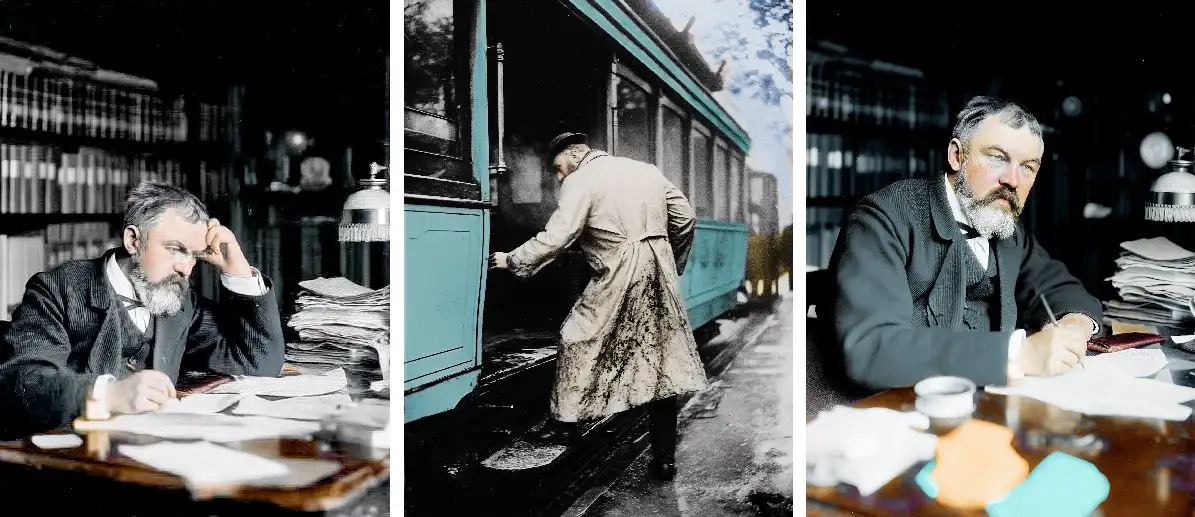
Photo by author with Midjourney
Subconscious Percolation
Make Creative Breakthroughs in Photography–
Or Anything Else
There is a secret trick that will give your creativity a new power.
It can be like magic, but it’s not a free lunch. And it doesn’t always work. But when it does, you’ll be amazed. It’s not a total secret. I’ve come across people in mathematics and in advertising who knew of and used this method. I’ve never heard a name for it, so I’m calling it ”Subconscious Percolation,” thinking about how coffee percolates up.
I discovered it in my teens reading a book about creativity in the mathematical field. It was called “The Psychology of Invention in the Mathematical Field.” by Jacques Hadamard.
 The author was both a psychologist and a mathematician. He interviewed several creative stars and studied how they worked. One was Albert Einstein, who was my hero starting in my teens. That’s why I bought the book. One of the other people interviewed was the great French mathematician Henri Poincaré. He is called “the last universalist,” because he was one of the last mathematicians to contribute to all the major branches of mathematics.
In the interview, Poincaré gives two stories showing how this method was accidentally discov-ered. In one story he describes working hard to prove that a certain kind of function cannot exist. He was unsuccessful, so he put the work aside and took a break.
That weekend he was taking a bus trip to an archaeological excavation with his mathematical project out of mind. Then as he was stepping onto the bus, he suddenly realized he had been wrong about the functions. They did exist, and there were two distinct classes of them. And they could be derived by some transformations from non-Euclidean geometry. He was sure that his new insight was right.
The work was done! He just had to write it up when he got back to Paris. It was like his brain kept working on the problem unconsciously after he stopped to take a break. Then when the puzzle was solved, it was presented it to his conscious mind in a completed form.
Poincaré now had a complete solution to a non-trivial problem. And the same kind of thing happened to me many times.
I Get Lucky
The quality of the results in my case was brilliant work, far beyond what I was capable of doing in my everyday work. Poincaré didn’t say that about his unconscious work, but I’m saying it about mine. It was always better than my regular work.
It started happening while I was studying advanced mathematics. It was like having a better mathematician living in my head when I worked under certain conditions. And it kept happening when I was working as a creative director in advertising. It hasn’t happened as often in my photography, because I don’t usually meet the right conditions, which I’ll describe below.
My Most Dramatic Example
I was an undergrad student in a graduate school class on algebraic topology. I wasn’t ready for this class, but I took it anyway. The professor assigned me a theorem to prove regarding intersections of compact Hausdorff spaces.
At the end of the week, I would have to go up to the blackboard and present this proof to an audience of mathematics students, each of whom was more sophisticated than I was. So at the beginning of the week, I worked on finding a proof. Finally after two or three days, I had something that worked. But it was ugly and betrayed my lack of finesse at that stage of my development.
At the end of the week, I went to the class, hoping to get for more time to work on my proof. Sometimes a presentation takes longer than expected, and you get a couple days until the next class. Then as I was parallel parking my car, to go to the class and maybe have to present my inelegant proof, something strange happened. I think this was the first time it ever happened to me.
A new proof for the theorem popped into my head as I was parking. I was backing into the parking space and definitely not thinking of anything mathematical. But there it was–a new proof, finished, short, and elegant. More elegant than anything I had ever done. And it was totally different from the proof I had done earlier in the week. Then I remembered the stories from Poincare that I had read many years before. It looked like the same thing was happening to me.
I wrote out the finished proof quickly before getting out of the car. There were only six or seven steps. My first reaction was confusion. There had to be something seriously wrong with it, something so obvious that I couldn’t notice. Turns out I didn’t get called during that class. The guy before me took a lot of time with his proof, which was long, filling seven or eight blackboards. So I had a couple more days before my presentation.
I went over the proof as carefully as I could, but couldn’t find any problems with it. It attacked the problem in a totally unexpected way. During the next class, two days later, I was finally called on to go to the board. I did so with trepidation. My fellow students could be unforgiving.
I started writing it out. The professor, whose appearance reminded me of President Eisenhower, was critical of my presentation. My mathematical English was unclear. He said to just write it like I was saying it. So I erased what I had written and started from scratch using more words and less notation than customary. Silence. No one said anything, which was unusual. Everyone studied it, but no one could find any flaws.
The professor said it was good and asked the students to copy it into their notebooks. Then he wrote on the board a longer proof that followed the more traditional path that I had done in my longer proof, only his was a little shorter and a lot more elegant than mine.
How This Works and the Conditions Required
Every time this has happened to me, it’s almost always the same.
1. There is an initial period of hard work. I said there was no free lunch. You work on the problem hard for a length of time, usually 2-3 days.
2. Then you stop working on it, and take a break for a couple days.
3. If you’re lucky, you’ll find the answer to your problem that you failed to solve consciouslywhile doing something routine. Many friends have told me they get their best ideas showering or shaving. Waking up from a dream is another. The other story of this happening to Poincaré was waking from a dream during a period of bad sleep caused by drinking too much coffee before going to bed.
The reason this hasn’t happened to me in photography is that I don’t usually meet the conditions. Unfortunately, I was too rushed. You need the period of intense work at the beginning, a period of rest following the conscious work, and then a casual routine activity for the solution to percolate up.
On those occasions when I have met the conditions, I was able to get the exciting results I hoped for. Sometimes you solve the problem consciously and are satisfied with the solution. So it doesn’t happen. It would happen when I was planning a series of sample images for myself. There would then be a more relaxed shooting schedule.
I remember a couture shoot in a Japanese garden in Boca Raton and another couture shoot in Ireland. There were days of planning and prep work. Happened both times. But when I did a series of calendars in LA over a 4-day shooting period, there was no time to get anything exceptional.
Has This Ever Happened to You?
It would be great to hear similar stories from people who have experienced this phenomenon. Be sure to include the conditions that allowed it to happen.
John Manning