
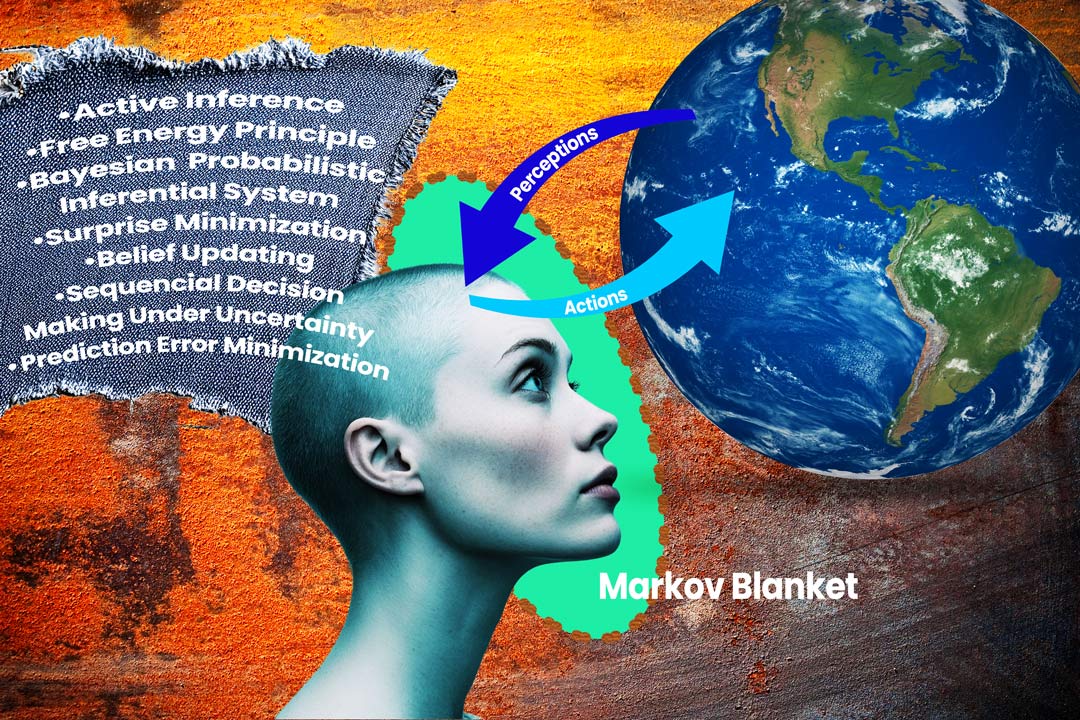
The Predictive Mind
Collage by Author
How to Become a Deep Generalist:
A Case Study
I’m in love with ideas.
Every day I come across some cool new ideas and add them to the pantheon with the others I live with.
Here’s what happens. Usually the name of the idea is enough to trigger my pursuit. Other times it has to do with its context.
I read or skim at least 50 articles a day. Most are nontechnical. Many are scholarly. When I come upon a concept I’ve never heard of before, one that intrigues me because of its name or the context it relates to, I dig into it.
Here’s How It Works
For example, let’s say the idea is “prediction error minimization mechanism.” This is a theory of how the brain handles perceptions, actions, and attention. I fist found this idea a little over 10 years ago and was instantly captivated.
I don’t remember how it went exactly in this particular case, so I’ll describe the most typical approach I use every day.
First I went into Wikipedia for a general, introductory view. I read the article and saved it, but I needed more on this idea. So I followed up with the references listed at the end.
Then I read about the creator of this theory, a neuroscientific theory of cognition and maybe of all life. I’ve been a sucker for theories of everything since Einstein’s failed attempts at a Unified Field Theory. My personal preferences added to the excitement.
These ideas describing our brain as a Bayesian prediction mechanism for how we adapt to the world, constantly re-adjusting and self-correcting to reality, became a shining beacon that throws new light on all my previous understanding.
I had never thought of it that way. I came to see Bayesian probability, where prior notions are adjusted by new evidence, as the essence of scientific thinking. Of all rational thinking.
This theory is the work of Dr. Karl Friston and his large team of researchers. Turns out he is widely respected and influential in research circles, and this theory of his is displacing the previous understanding of brain processing.
On YouTube I watched several interviews with and lectures by Dr. Friston. Checked out the references he gives. Downloaded and read many papers on the topic. Found a couple of books he authored or recommended, which I re-read frequently.
Now, ten years later, my interest in this cluster of concepts continues to grow. And it becomes more important in my thinking.
The New Concept Becomes Part of Who I Am
Almost on its own, this idea integrates itself into my preexisting ideas, for example the Kantian epistemology I studied for one quarter in grad school 40 years ago. It discussed the gulf between the phenomena that we observe and the noumena that are out there.
Friston talks about a Markov blanket, a statistical mechanism that separates the knower from the known, internal states from external reality. It’s what allows organisms to maintain their individual identity and not be absorbed into the environment.
Then comes the adapting of the older ideas to accommodate the new theory, following the kind of evolution described by Hegel’s dialectic and Whitehead’s process philosophy. Topics I’m studying currently after putting them off for years.
And this takes my understanding of Friston as well as Kant, Hegel, and Whitehead to greater depth, maximal clarity, and seamless integration.
And it makes me pity the poor generalist who never gets a ticket to this show.
From Specialist to Generalist
In 7th and 8th grade, I had a science teacher I respected. He used to say that a generalist is someone who knows less and less about more and more. And a specialist is someone who knows more and more about less and less.
I was never sure where he came down on this divide. But I was falling in love the Einstein’s General Theory of Relativity, the theory of gravitation as a result of curved 4-dimensional space-time. Thinking of this became a major part of my thinking.
I saw then that only specializing in something I love this much would ever satisfy me.
But as you live and learn, your ideas change. I ended up becoming a serial specialist. Moving on to a new field to conquer didn’t replace my interest in the previous field. I would just put it on hold for a while as I began digging in other fields.
And there’s another factor that facilitates this process. Most people know it’s easier to make money, once you already have some. The same thing happens with knowledge acquisition. The more you know, the more you can know.
It becomes faster and easier as you develop more expertise. Your existing background helps you assimilate and understand new things.
The process is mostly structural, and structures have a lot in common from one subject to the next. When I march into a new subject area, I come armed with experience from having already done this so many times. Very little stands in my way.
Later in life I had to realize that I had become the generalist I had always abhorred.
I studied and worked as a specialist in areas as different as theoretical physics, futures trading, fashion photography, digital image retouching & compositing, neoliberal economics, and brand personality marketing.
All this effort in areas I’ve worked on for years or decades is now supplemented by learning new fields like using LLMs for research and data structure. I’m beginning to learn the building of agentic systems.
Here again old knowledge and skills add color to new studies. The courses I took decades ago in Foundations of Mathematics, on topics like Turing machines, partial recursive functions, and computability, make my study of modern AI more robust. And not as strange as it seems to be to people lacking that kind of background.
Specialists Play a Critical But Limited Role in Developing Understanding
I appreciate the arena of the specialist. She sees things hidden from the eyes of nonspecialists. She walks comfortably through exotic gardens forever off-limits to non-specialists. But she misses most of the connections between those gardens.
The real world is pan-relational. Specialties are supremely useful constructs, but the exist only in the brain and in the classroom. Out there in reality, everything is always connected. You find, for example, the human body as a whole. It’s never divided up into anatomy and physiology.
So to understand anything well, at least as advance from early stages, you must preserve the connections. Hence the need for a generalist.
It often takes a generalist to understand all the areas that need to be connected, for example, when a team of diverse specialists work together on a wicked problem. And it often takes a generalist to facilitate communication between knowledge workers in those different areas.
A Deep Generalist Can Bring a New Point of View
The deep generalist has an even greater advantage. Many of the most interesting and important ideas aren’t found in a preliminary survey of an idea. You need to get past the introductory articles and probe deeper to find the buried gold. How to do this effectively is a familiar activity for the deep generalist.
When I started to learn General Relativity, the materials I learned from were written for a young student or a layman with no background in physics or mathematics. A lot of the overly simplified teaching got the science all wrong. I wasted a year of my young life and still resent it.
Fortunately, my interest caused me to keep going deeper. It meant learning lots of new mathematics to be able to even read the right books and articles. But in addition to learning the subject, it also taught me what it’s like to add real depth to your learning. A lesson I never forgot.
This need for depth and generalized understanding will become obvious to all as our knowledge advances. The need for partnerships between specialists and generalists will become more critical.
And the deep generalists will be the glue that binds team members to the common project. This will be true in the work itself and in communicating the results to specialists and non-specialists alike.
Encouraging More People to Follow
The exact path you choose will depend on the subject, your current expertise in that subject and closely related subject. And it depends on how much depth you need or desire. But at all levels a clear and accurate understanding is paramount.
It’s not as hard to achieve as you might imagine. And it gets easier as you move forward. You might even be able to do this without a vigorous curiosity, but it wouldn’t be as much fun.
You can use LLMs to help with this by requesting questions and not only answers. Ask the model for a critical analysis of your position and understanding. Ask it to challenge your ideas and sort out the weaknesses. If you prompt it well and supply the needed context, it will be like having a faculty advisor review the progress of your work.
Add epistemology to your repertoire. As Thomas Huxley would say, excel at the art of slaying a beautiful hypothesis with an ugly fact. Especially when you or your culture cherish that hypothesis! This improves the quality of your learning.
But don’t go too far the other way either. You can appreciate the beauty of ideas without being married to them or letting them hold you back.
It would be great to hear from anyone who is on a similar journey or anyone who would like to get started on this mission. If any reader is interested in pursuing this path, I would like to hear from you. Maybe I can offer some advice and encouragement that might help you on your adventure.
Imagine a World Where Everyone Became a Deep Generalist
When you met a new person, she would be a deep generalist like you. Most of the time her areas of deep specialization will be different from yours, which would lead to interesting and passionate exchanges of ideas. Exciting conversations.
Once in a while, you’ll come across a person with areas of interest similar to yours. That could be even more exciting as you share your different perspectives on the same topics, offering each a chance to grow.
In either case, you would be able to experience a deep connection with this new person instead of just exchanging pleasantries and small talk. And there would be a great sense of camaraderie. Instead of each of us living isolated in our own silos, there would be much more that is shared. There would be community.